AI Tweet Generator: Complete 2026 Guide and Best Practices
AI tweet generation in 2026: how tools work, prompting techniques, format patterns, AI tells to edit out, voice drift prevention, and velocity integration.

An AI tweet is a post on X (formerly Twitter) generated, drafted, or refined with the help of an AI model. The category has matured rapidly in 2026: specialized tools understand thread structure, hook patterns, format-specific best practices, and the algorithmic preferences that shape X's For You feed. With X impressions per post down 5.3% year over year and median engagement at 0.015%, the right AI tweet workflow can double or triple your output without sacrificing the quality that drives real engagement.
This guide covers everything about AI tweet creation in 2026: how AI tweet tools work, the prompting techniques that produce strong output, the format patterns the X algorithm rewards, the AI tells to remove during edit, the integration with engagement velocity that turns AI-assisted content from sludge into compounding growth, and the workflow that combines AI generation with disciplined human review. Whether you are new to AI writing or auditing your existing AI workflow, this is the 2026 reference.
How AI Tweet Tools Work in 2026
Modern AI tweet tools combine three technical layers.
Layer 1: Foundation Language Model
Tools use GPT-4, Claude, Gemini, or open-source LLMs under the hood. The raw language model handles text generation.
Layer 2: X-Specific Training and Prompting
The best tools are fine-tuned or prompt-engineered on millions of high-performing X posts. They learn hook patterns, ideal length, thread structure, and content patterns that drive engagement.
Layer 3: Format and Algorithm Awareness
Top-tier tools understand 280-character standard limits, 25,000-character Premium long-form, thread structure (hook + body + payoff), and 2026 algorithmic preferences (high weight for retweets and replies, low weight for likes).
Tools missing the second and third layers produce generic AI text that performs poorly. The good ones produce posts that look human-authored after light human edit.
The Six Categories of AI Tweet Tools
| Category | Cost / Month | Best For |
|---|---|---|
| Generic LLM (ChatGPT, Claude) | $0-20 | Flexible generation with custom prompts |
| Tweet Hunter | $49+ | Hook library, AI generation |
| Typefully AI | $25+ | Thread composer with AI assist |
| Postwise | $29+ | AI replies and thread generation |
| Hypefury AI | $19+ (paid tier) | Combined AI + scheduling |
| Xarmy AI | Free to start | AI + community velocity |
For solo creators, Xarmy AI combined with X-specific generation covers most use cases. For thread-heavy strategies, Typefully AI is strongest. For maximum prompting flexibility at lowest cost, ChatGPT Plus or Claude with strong prompts.
Prompting Techniques That Produce Strong AI Tweets
The quality of an AI tweet depends heavily on the prompt. Five patterns lift AI tweet quality dramatically.
1. Specify the Format
"Write a 280-character standalone tweet" beats "write a tweet." Tell the tool whether you want thread, single tweet, image caption, or reply.
2. Specify the Hook Style
"Lead with a contrarian hook" or "lead with a specific number" or "lead with a question" produces sharper results than open-ended prompts.
3. Specify the Voice
"Write in the voice of a senior B2B operator who has seen the topic many times" or "write in the voice of a fired-up founder" guides tone effectively.
4. Specify the Goal
"Optimize for retweets" versus "optimize for replies" versus "optimize for bookmarks" produces different outputs. Tell the tool which algorithmic signal you want.
5. Provide a Reference
"Make this similar in style to: [paste an example of a tweet that performed well for you]" anchors generation in your authentic voice.
According to Digital Applied's 2026 marketing report, AI tweets using these prompting patterns achieve 60-80% of human-written tweet engagement versus 20-30% for naive prompts.
Format Patterns the 2026 Algorithm Rewards
AI tweet output should match algorithmically preferred formats.
Strong Thread Structure
- Tweet 1: hook (strong opener creating curiosity)
- Tweets 2-6: body (concrete points, examples, numbers)
- Tweets 7-8: payoff (key insight or actionable takeaway)
- Final tweet: CTA (subscribe, follow, link)
Strong Single Tweet Structure
- First sentence: hook
- Middle: specific claim or insight
- Optional last sentence: implication or question
Strong Reply Structure
- Acknowledge the parent tweet briefly
- Add value, perspective, or counterpoint
- Optional: question or hook for further discussion
According to Sprout Social's 2026 industry data, posts following these format patterns achieve 2-3x higher engagement than free-form posts at identical content quality.
AI Tells to Remove During Human Edit
Six patterns that mark posts as obviously AI-generated and hurt engagement.
- Generic hooks: "Have you ever wondered..." or "Let me tell you about..."
- Excessive emojis: 3+ emojis per tweet reads as AI or low-quality
- Buzzword density: "synergy, leverage, holistic" stacked together signals AI
- Hedge phrases: "It's important to note that..." adds nothing
- Overly polite tone: X is direct; AI's default politeness reads as soft
- Symmetric structure: "First X, second Y, third Z" symmetry is an AI signature
Strong AI workflow uses AI for ideation and drafting, then human edit for voice and to remove AI tells. Pure AI output without edit performs poorly across the platform.
The AI Tweet Generator + Edit Workflow
5-minute workflow that turns AI output into high-quality posts.
Step 1: Generate 3-5 Variations (2 minutes)
Prompt the tool with format, hook style, voice, goal. Generate 3-5 variations rather than committing to the first output.
Step 2: Pick the Strongest (1 minute)
Select the variation closest to your voice and goal.
Step 3: Human Edit (2 minutes)
Remove AI tells (hedging, generic hooks, buzzwords). Add specific examples from your experience. Adjust voice to match your style. Cut filler.
Compared to writing from scratch, this workflow produces 2-3x more posts in the same time while maintaining or improving quality. Solo creators who adopt it typically publish 200-300 more posts per year.
Where AI Tweets Plateau Without Velocity Boost
AI generation solves content quality and ideation. It does not solve engagement velocity.
Why Standalone AI Tweets Plateau
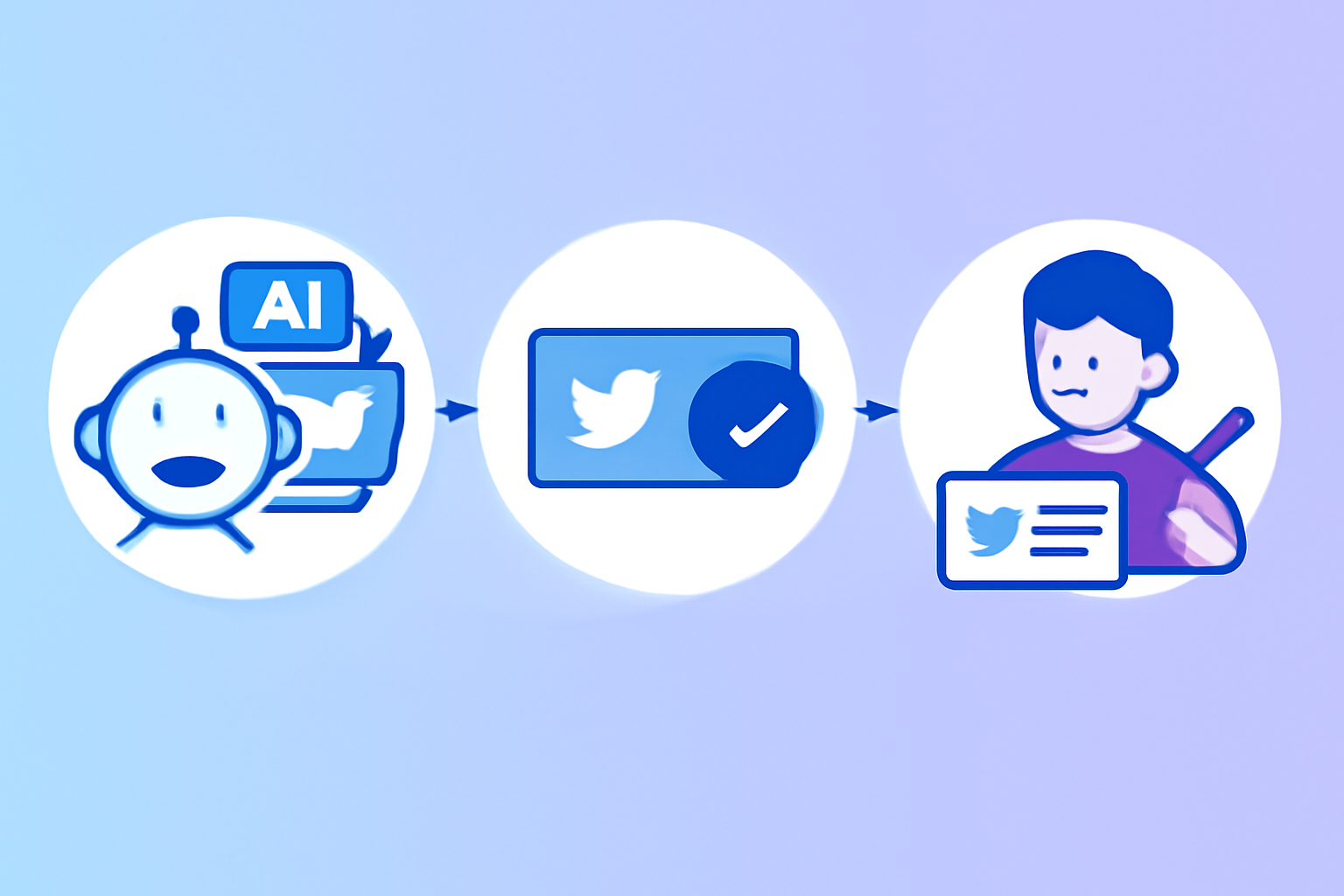
Even excellent AI-generated tweets fail without first-30-minute engagement velocity. The algorithm reads weak velocity as low quality and suppresses reach. Without engagement boost, AI tools help you write more posts that the algorithm ignores.
Why AI + Community Amplification Wins
Community amplification platforms boost first-30-minute velocity through real verified creator engagement. Combined with AI generation, the stack produces both content volume and algorithmic boost.
Average reach lift from AI + velocity stacks: 200-500%, often comparable to $3,000+ monthly agency budgets at a fraction of the cost.
X Premium and AI Tweet Synergy
X Premium subscribers can post tweets up to 25,000 characters. AI generation handles long-form especially well.
Long-Form Tweet Use Cases
- Replacing 8-10 tweet threads with single long-form posts
- Detailed product launches with full context
- Industry analysis with depth and examples
- Personal essays and stories
For X Premium subscribers, AI tweet tools that handle 25,000-character formats are a force multiplier. Most tools in 2026 support both standard and Premium formats; verify before subscribing.
Common AI Tweet Mistakes
Five patterns that turn AI tweet workflows into wasted effort.
- Trusting raw output: publishing unedited AI text produces low engagement; always human-edit
- Generic prompting: "write a tweet about marketing" generates generic AI sludge
- Voice drift: over-relying on AI causes your X voice to converge with everyone else's AI
- Ignoring velocity: generating more content without first-30-minute engagement boost wastes the volume
- Tool sprawl: subscribing to 4 AI tools and using none consistently produces less output than one used daily
The most common mistake is the first. Our engagement rate guide covers how to measure whether your AI tweet workflow is producing engagement growth.
The 2026 Platform Reality for AI Tweets
Three trends shape what AI tweet workflows must address.
Retweets up 35%, replies up 21% YoY. The algorithm rewards conversation. AI tweets tuned for conversation-driving content outperform AI tweets optimized for likes.
Impressions per post down 5.3% YoY. Each post matters more. Volume from AI without quality lift does not compensate; quality must accompany volume.
X paid creators grew $260M to $415M. Serious accounts monetize multiple ways. AI tweet workflows that support consistent posting across formats become force multipliers for revenue.
According to Metricool's 2026 study of 1.1 million X posts, accounts using AI tweets with human edit see 40-60% higher engagement than accounts using either pure AI or pure human writing at identical post volumes.
How to Avoid Voice Drift With AI Tweets
The biggest long-term risk of AI tweet workflows: your voice converging with everyone else's AI output.
1. Audit Your Output Monthly
Read 20 of your recent tweets. Do they sound like you? Or do they sound like generic AI? If they drift toward generic, the AI is too dominant in your workflow.
2. Keep Human-Only Time
Write 1-2 tweets per day completely from scratch without AI. Preserves authentic voice and prevents over-reliance.
3. Reference Your Best Past Tweets
When prompting, include "match the voice of [your high-engagement past tweet]." Forces AI to anchor in your authentic style.
4. Heavy Edit on AI Output
Replace 30-50% of AI output text during edit with your own phrasing. Even if the structure stays, voice stays yours.
Our X thread reader guide covers how to study high-engagement content to refine your voice anchor.
How Xarmy Combines AI Tweet Generation With Velocity
The 2026 insight: AI tweet generation alone produces marginal lift; AI tweets combined with community-driven engagement velocity produce compounding growth.
Our AI-powered platform generates X-specific content (single tweets, threads, replies, long-form) tuned for the 2026 algorithm, lets you schedule at optimal times, and provides community-driven engagement velocity from 10,000+ verified creators to capture the first-30-minute window. Average reach lift: 450%.
The integrated approach replaces separate $20/month subscriptions for AI generation, scheduling, and engagement at lower total cost while addressing the 2026 algorithm's velocity preference directly. For solo creators, brands, and B2B operators, it is the formula that consistently produces top-decile growth in 2026.
Frequently Asked Questions
What is an AI tweet in 2026?
An AI tweet is a post on X generated, drafted, or refined with AI tool assistance. The category covers everything from raw ChatGPT output to specialized tools like Tweet Hunter, Typefully AI, Postwise, and Xarmy AI that fine-tune on X-specific patterns. Best practice in 2026 uses AI for ideation and drafting (saving 60-70% of writing time), then human edit to remove AI tells and inject authentic voice before publishing. Pure AI output without edit performs poorly (20-30% of human engagement); AI plus edit performs well (60-80%).
Are AI tweets allowed on X (Twitter) in 2026?
Yes, when properly edited. X allows AI-assisted content as long as it complies with platform rules. The risks are reputational, not platform-side: unedited AI text reads as generic and reduces engagement, voice drift causes your X presence to feel impersonal, and pure auto-publishing without review can produce tone-deaf content. Best practice is to use AI for ideation and drafting, then edit for voice and to remove AI tells before publishing.
How do I write AI tweets that perform well?
Five prompting techniques produce strong AI tweets: specify the format (thread vs single vs reply), specify the hook style (contrarian, question, specific number), specify the voice (operator vs founder vs creator), specify the goal (optimize for retweets vs replies vs bookmarks), and provide a reference example from your past high-engagement content. After AI generates 3-5 variations, pick the strongest and edit 30-50% of the text to inject your voice and remove AI tells (generic hooks, excessive emojis, buzzword density, hedge phrases, symmetric structure).
An AI tweet in 2026 is a force multiplier when combined with disciplined prompting, human edit, and engagement velocity boost. Use AI to accelerate output, not replace voice. Try our AI-powered platform for free to combine AI tweet generation with real engagement velocity from 10,000+ verified creators, the formula that consistently turns AI-assisted content into compounding growth rather than algorithmic noise.