AI Tweet Generator: Draft 30 X Posts in 90 Minutes for 2026
AI tweet generator workflows draft tweets in seconds using voice-trained LLMs; full 2026 guide on top tools, prompts, and the editing process that lifts engagement.


Writing 30 high-quality tweets a week from scratch is grueling. Most creators eventually hit a wall: ideas dry up, hooks repeat, and engagement flatlines. An AI tweet generator changes the math by producing 30-50 drafts in 5 minutes, freeing you to edit, polish, and ship rather than stare at a blank compose box. Done right, AI tools lift weekly output 3-5x without flattening your voice.
This guide breaks down what AI tweet generators actually do in 2026, the categories of tools that work (general-purpose AI, X-specific AI, voice-trained AI), how to prompt them for high-performing output, the editing process that turns AI drafts into post-worthy tweets, and the metrics that prove whether your AI workflow actually lifts engagement. By the end you will have a complete AI-assisted compose pipeline.
What AI Tweet Generators Actually Do
AI tweet generators are tools that produce tweet drafts from prompts. The simplest accept a topic and return 5-10 variations. The advanced ones learn your voice from past tweets, suggest format choices, and optimize for engagement triggers (hook patterns, length, hashtag use).
The 2026 landscape splits into three categories:
- General-purpose LLMs (ChatGPT, Claude, Gemini): $20-$200/month. Powerful and flexible. Require manual prompting and voice training.
- X-specific AI tools (Hypefury AI, TweetHunter): $19-$49/month. Pre-trained on viral X content. Includes scheduling and analytics.
- Voice-trained AI platforms: Custom or premium tiers. Learn your specific tone, common topics, and hook patterns from your historical posts.
Most successful creators combine two: a general-purpose LLM for novel ideation, plus an X-specific tool for format-aware drafting and scheduling.
How AI Tweet Generation Works Under the Hood
Modern AI tweet generators use large language models trained on conversational data, including X public posts. When you prompt them with a topic, they generate candidate drafts by predicting the most likely word sequences for that topic in tweet format (compressed, hook-first, conversational).
The quality of output depends on three factors:
- Model size and capability: Larger models (GPT-4 class, Claude Sonnet/Opus) produce more nuanced drafts.
- Prompt specificity: Generic prompts ("write a tweet about X") produce generic drafts. Specific prompts (with voice guidance, hook pattern, length target) produce sharper output.
- Voice training: Feeding 20-50 of your best historical tweets as examples teaches the model your specific style.
According to Digital Applied's 2026 marketing report, accounts using AI for tweet drafting in 2026 see 30-50% engagement rate lift after 90 days of consistent workflow, compared to manual-only or pure-AI accounts.
Five Prompts That Produce High-Performing Tweet Drafts
Specific prompts that work across ChatGPT, Claude, and Gemini.
Prompt 1: The Stat-Backed Insight
"Write 5 tweet drafts (100-180 chars each) using this stat: [your stat]. Each tweet should open with a specific number or contrarian claim. End with an open invitation for replies. Match my voice: [paste 3 of your best historical tweets]."
Prompt 2: The Framework Thread
"Turn this framework into a 6-tweet thread: [your framework]. Tweet 1: hook with a number or contrarian claim. Tweets 2-5: one framework step per tweet, with a concrete example. Tweet 6: CTA to follow for more frameworks like this. Match my voice."
Prompt 3: The Hot Take
"Generate 5 contrarian takes about [topic]. Each must be 100-150 chars, controversial enough to drive replies, but backed by reasoning you can briefly justify. No clickbait that lacks substance."
Prompt 4: The Story Snippet
"Turn this 3-sentence story into a single tweet: [your story]. Compress to 180 chars. Open with the most vivid detail. End with a generalizable lesson."
Prompt 5: The Reply-Driving Question
"Write 5 X questions that drive replies in [your niche]. Specific scenarios, not generic 'what do you think?'. Each must invite a concrete answer."
Top AI Tweet Generator Tools in 2026
| Tool | Type | Cost | Strength |
|---|---|---|---|
| ChatGPT Plus | General LLM | $20/month | Most flexible prompting |
| Claude Pro | General LLM | $20/month | Longer context, better voice training |
| Gemini Advanced | General LLM | $20/month | Strong with current events |
| Hypefury | X-specific | $19+/month | Drafting + scheduling + recycling |
| TweetHunter | X-specific | $49+/month | Viral tweet inspiration library |
| Magic Tweet | X-specific | $29+/month | Hook pattern automation |
| X native AI assistant | X-specific | Free with Premium | Integrated, basic |
| Xarmy AI Compose | X-focused + community | Free to start | Voice-trained + verified engagement |
For most creators, the combination of ChatGPT or Claude ($20/month) plus Hypefury ($19/month) covers everything. Total: $39/month for a full AI compose stack with scheduling.
Voice Training: The Step Most Creators Skip
The single biggest mistake with AI tweet generators is using them without voice training. Default outputs sound generic. Voice-trained outputs sound like you.
How to Train an LLM on Your Voice
Pull 20-30 of your best historical tweets (highest engagement rate, most representative of your style). Feed them to ChatGPT or Claude with this prompt: "Analyze the writing style in these tweets. Identify the tone, sentence structure, hook patterns, common topics, and any verbal tics. Summarize as a 'voice guide' I can reuse in future prompts."
Save the analysis as a system prompt or reusable template. Every future tweet generation request starts with: "Match this voice: [paste analysis]. Write tweets that sound like me." Output quality jumps dramatically.
How to Train Hypefury or TweetHunter
These tools have built-in voice training. Upload your historical tweets via CSV or paste-in interface. The tool analyzes and applies your voice to future drafts automatically.
The Editing Process That Turns AI Drafts Into Winners
AI drafts are 60-80% there. The final 20-40% is editing. Five-minute editing process per tweet.
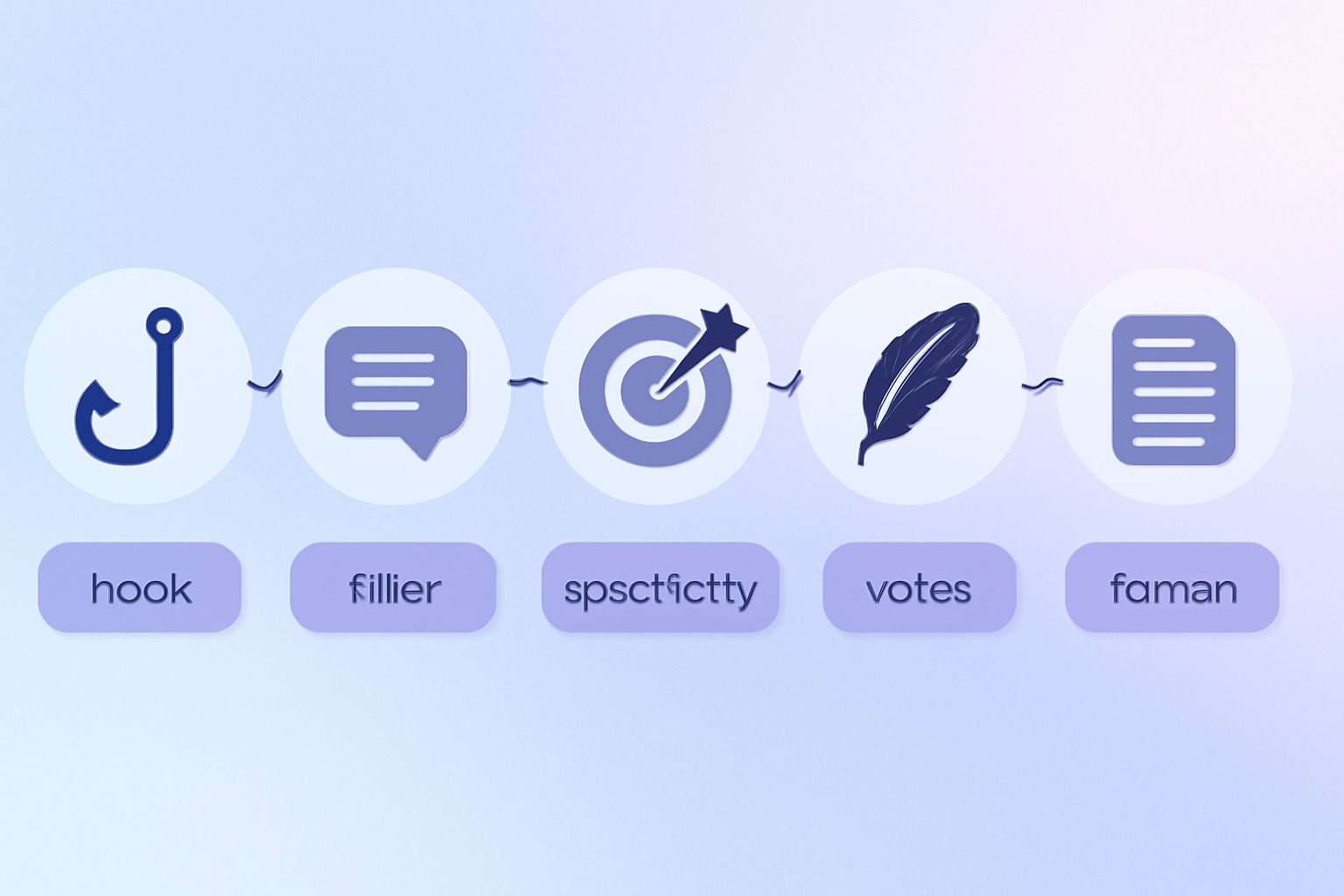
Pass 1: Hook Strength
Is the first 5-7 words compelling? If not, rewrite the opener using one of the six hook patterns (specific number, contrarian claim, vivid scene, open loop, direct question, stat-backed authority).
Pass 2: Filler Cut
Strip filler words: "just," "really," "very," "actually," "I think." Each cut buys 5-10 characters.
Pass 3: Specificity Injection
Replace generic words with concrete details. "Many users" becomes "47% of users." "A while ago" becomes "in 2024."
Pass 4: Voice Sharpening
Read the tweet aloud. Does it sound like you would actually say it? If not, replace stilted phrasing with conversational equivalents.
Pass 5: Format Polish
Add 1-2 line breaks if absent. Bold key phrases via emphasis if appropriate. Confirm hashtags fit (1-2 max).
Total: 90 seconds per tweet. ROI: 30-50% engagement rate lift versus pure AI output.
The AI Workflow That Ships 30 Tweets in 90 Minutes
Most successful creators batch-write using this exact sequence.
Minute 0-15: Idea Capture
Pull 15-25 raw ideas from your notes, news feed, competitor posts. No editing, just capture.
Minute 15-45: AI Draft Generation
Feed ideas into your voice-trained ChatGPT or Claude in batches. Generate 3-5 variations per idea. Get 45-75 drafts total.
Minute 45-75: Edit and Select
Five-pass edit on each candidate. Cut the weakest 50%. Keep your best 30.
Minute 75-90: Schedule
Open Hypefury or your scheduler of choice. Distribute the 30 tweets across the week at peak times (Tuesday-Thursday 12-6 p.m. local for most audiences).
Total: 90 minutes for 30 tweets. The math beats manual posting by 5-10x and beats pure AI by 2-3x on engagement quality.
Common AI Tweet Generator Mistakes
Five patterns that produce mediocre AI output.
- No voice training: Default LLM tone is generic. Always feed 20-30 voice examples.
- Too-broad prompts: "Write a tweet about marketing" produces nothing useful. Specify topic, intent, length, hook type.
- Shipping without editing: Pure AI output sounds AI-generated. Five-pass editing is non-negotiable.
- Same hook every time: AI defaults to safe openers. Force variety by rotating through the six hook patterns.
- Set-and-forget posting: AI scheduling without engagement velocity in the first 30 minutes after each post kills reach. Block reply windows after every scheduled tweet.
Measuring Whether AI Actually Lifts Your Engagement
Track three metrics for 30 days after starting an AI workflow.
Engagement Rate Lift
Calculate your average engagement rate for 30 days before AI versus 30 days after. Target: 30-50% lift. Below 20% means your voice training or editing process needs work.
Volume Multiplier
Compare tweets per week before and after. AI workflow should produce 2-5x output without lower quality. If volume is the same but quality drops, you are using AI as a crutch.
Cadence Consistency
Standard deviation of daily tweet count. AI workflow should produce tighter consistency (less variability). Burnout-driven gaps disappear.
Our engagement rate calculator guide covers the math and benchmarks. Retweets surged 35% year over year on X in 2025 (4.93 to 6.67 per post on average) according to Metricool's 2026 study, and AI-assisted accounts captured a disproportionate share of those gains.
Frequently Asked Questions
Are AI tweet generators allowed by X (Twitter)?
Yes. AI-drafted tweets are fully allowed. What is banned is bot behavior (auto-following, auto-engaging, duplicate content across accounts). Using AI to draft your own original tweets that you review and ship manually does not violate any X policies.
Can AI write tweets that go viral?
AI can draft tweets with viral mechanics built in (strong hooks, native format, engagement triggers). But virality depends on engagement velocity in the first 30 minutes after posting, which is a human-driven signal. AI handles drafting; you handle the post-publish engagement that turns drafts into hits.
How much does an AI tweet generator cost?
The most popular stack is ChatGPT or Claude ($20/month) plus Hypefury or TweetHunter ($19-$49/month), totaling $39-$69/month. X-specific tools like Xarmy offer free tiers that cover most solo creator needs. Voice training requires no additional cost beyond the base subscription.
A well-prompted AI tweet generator is the highest-leverage productivity tool on X in 2026. Train it on your voice, edit aggressively, and ship 3-5x more content without quality loss. Try our AI-powered platform for free to combine voice-trained AI drafting with real engagement from 10,000+ verified creators, the formula that consistently lifts every AI-assisted account above the 0.015% median.