Twitter Impressions: What They Mean and How to Grow Them


Every post you publish on X (formerly Twitter) competes for a finite amount of attention. According to Statista, the average X post generated 2,711 impressions in 2025, down from 2,864 in 2024. That dip might sound modest, but when multiplied across an active posting schedule, it translates into thousands of lost eyeballs each week.
Understanding impressions on Twitter is the first step toward reversing that trend. Impressions quantify raw visibility: how often your content loads on a screen, regardless of whether someone clicks, likes, or replies. Paired with engagement data, they reveal whether your content is being seen and whether it is resonating. This guide breaks down the metric in full, examines the latest benchmarks, and offers actionable tactics to help you increase your reach on the platform.
What Are Twitter Impressions and Why Do They Matter?
An impression is counted each time your post appears in another user's timeline, search results, or thread. If the same person scrolls past your post three times, that registers as three impressions. The metric does not confirm that anyone read or interacted with your content; it simply confirms delivery.
This distinction is important. Impressions measure content visibility, while engagement metrics such as likes, replies, and reposts measure action. A post with 5,000 impressions and 50 engagements converts at a 1% Twitter engagement rate, which is above the platform average. A post with the same 5,000 impressions and only 5 engagements signals a delivery problem, a relevance problem, or both.
For a deeper breakdown of how the metric works, see our guide on Twitter impressions explained.
2025 Benchmarks: How Many Impressions Should You Expect?
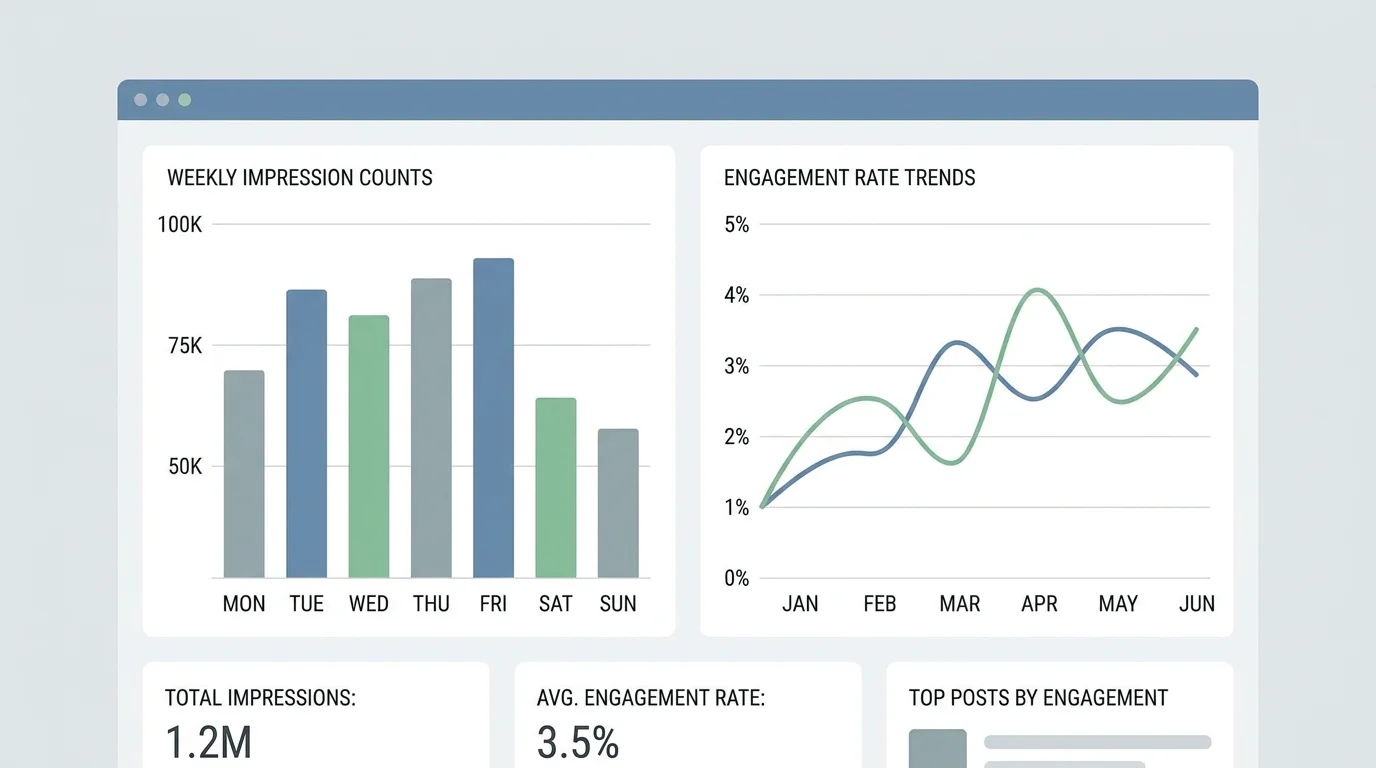
In 2025, X posts generated an average of 2,711 impressions, down from 2,864 impressions in 2024. That represents a roughly 5% year-over-year decline. Yet the picture is not entirely negative. Those impressions have a bigger impact now, as engagements see an uptick. The average engagement on X posts increased across every type of interaction between 2024 and 2025.
Specifically, posts on X generated an average of 32.89 likes in 2025, up from 30.25 likes in 2024. Replies and retweets also increased year-over-year, with the average post receiving 2.56 replies and 6.67 retweets. Fewer impressions, higher engagement: this suggests that the Twitter algorithm is distributing content more selectively to audiences that are likely to interact.
Earlier in the cycle, the jump was even more dramatic. In 2024, X posts generated an average of 2,121 impressions, 98.24% more than in 2023. While impressions increased massively, engagement levels decreased by 38.05% overall. However, interactions rose slightly by 8.85% as well. Taken together, the data tells a clear story: visibility on the platform is volatile, and consistent growth demands an intentional strategy.
Impressions vs. Reach vs. Engagement: Clarifying Key Terms
Confusion between these three metrics is common, so precision matters.
- Impressions count total appearances of a post, including repeat views by the same user.
- Reach counts the number of unique users who saw the post. X does not publicly report reach as a standalone metric, but third-party tools often estimate it.
- Engagement measures actions taken on the post: likes, replies, reposts, link clicks, and profile visits.
For a full overview of how these data points interconnect, consult our resource on Twitter metrics. The relationship between impressions and engagement is expressed as the engagement rate. If you want to learn how to calculate engagement rate on Twitter, the standard formula divides total engagements by total impressions across a defined set of posts.
What Drives Impressions on X?
Several factors determine whether your post earns 200 impressions or 20,000. Understanding each one helps you focus your efforts where they will have the most impact.
The Algorithm and Content Relevance
X uses a recommendation algorithm that surfaces content based on recency, predicted engagement, and topic relevance. Posts that receive early interactions, especially replies and reposts, are shown to a wider audience. X keeps promoting tweets that receive a lot of interaction and are new, emphasizing the importance of how often you post.
Post Format
Tweets with video can get 10 times higher engagement. Tweets with images get 150% higher engagement, while GIF tweets see 55% more engagement. Visual posts earn more interactions in the critical first minutes, which in turn signals the algorithm to distribute them more broadly, resulting in more impressions.
X users watched 8.3 billion videos daily in 2024, a 40% year-over-year increase. That surge in video consumption means creators who incorporate short, high-quality video are well positioned to capture a disproportionate share of post visibility.
Posting Frequency and Timing
Based on Statista reports, X users are posting more on the platform. The average number of weekly posts jumped from 15.97 in 2024 to 17.34 in 2025. Higher frequency correlates with greater total impressions, but only when quality remains consistent. Flooding timelines with low-value posts can suppress algorithmic distribution.
Posting at 6 a.m. Monday leverages peak engagement for better reach. Testing different time windows through Twitter analytics will help you identify the slots that work best for your specific audience.
Community Engagement: The Multiplier Most Creators Overlook

Algorithms reward early engagement signals, but generating those signals organically is time-consuming. The platform records over 100 billion impressions daily across all content. In the US, 75% of all posts are retweets or replies; only about 15% are original content. The implication is clear: reposts and replies drive a large portion of the impressions on the platform.
This is where mutual support communities become powerful. When real accounts consistently like, reply to, and repost your content within the first hour of publication, the algorithm interprets that activity as a relevance signal and distributes the post further. The result is a compounding visibility loop: more early engagement leads to more impressions, which leads to more organic engagement.
Our AI-powered engagement community was built around this principle. By matching your posts with verified, relevant accounts, we help you generate the early signals that the algorithm rewards, all while staying compliant with X's terms of service.
Practical Strategies to Increase Your Impressions on Twitter
Below is a consolidated action plan you can implement today.
- Lead with visuals. Attach an image, video, or GIF to every post. Visual content consistently outperforms plain text in both engagement and algorithmic reach.
- Optimize posting cadence. Aim for 2 to 5 original posts per day. Track your tweet stats to confirm that additional posts are not diluting per-post impressions.
- Engage before you post. Spend 15 minutes replying to other accounts in your niche. This warms the algorithm and places your profile in front of potential followers.
- Use threads for depth. Multi-post threads keep readers on your profile longer, generating multiple impressions and signaling value to the algorithm.
- Leverage hashtags sparingly. Tweets that use up to two hashtags and stay under 100 characters tend to perform better. Overloading a post with hashtags can reduce readability and engagement.
- Reply quickly. Reply to all comments within the first few hours after you post to keep the conversation going. Active threads generate additional impressions as new participants view the entire conversation.
Tracking and Interpreting Your Impression Data
X provides a built-in Post Activity Dashboard that shows impressions, engagements, and engagement rate for every post. You can filter by date range and export data as a CSV file for deeper analysis.
When reviewing your data, focus on three patterns:
- Impression trends over time. A consistent upward curve means your content strategy is aligned with the algorithm. A plateau suggests you need to experiment with new formats or topics.
- Impression-to-engagement ratio. If impressions are high but engagement is low, your content is being seen but is not compelling enough to earn clicks. The average engagement rate per post from an X influencer in 2025 was 0.39%. Use this as a reference point.
- Format performance. Text posts saw a slightly higher engagement rate at 0.48%. Link posts had a significantly lower engagement rate at 0.13%. Comparing formats within your own data will reveal what resonates with your particular audience.
| Post Format | Avg. Engagement Rate (2025) | Best Use Case |
|---|---|---|
| Text | 0.48% | Thought leadership, hot takes |
| Photo | 0.41% | Product showcases, infographics |
| Video | 0.41% | Tutorials, behind-the-scenes content |
| Link | 0.13% | Blog distribution (pair with a summary) |
The Scale of Opportunity on X
Despite recent declines in per-post impressions, the platform remains enormous. X recorded approximately 557 million monthly active users worldwide as of mid-2025. The platform generates roughly 500 million posts per day and pulls in 3.8 billion monthly website visits.
58% of the platform's users engage with brand content every week. That percentage, applied to a user base of over half a billion, represents hundreds of millions of brand-relevant interactions. For solo creators, startup founders, and marketing teams, Twitter impressions remain one of the most cost-effective levers for building Twitter exposure.
Understanding impressions on Twitter is not a vanity exercise; it is a strategic discipline. The data shows that while average impressions fluctuate year over year, the accounts that consistently earn above-average visibility share a common trait: they combine high-quality content with reliable early engagement signals. Whether you accomplish that through manual outreach or through a structured community approach, the principle remains the same.
If you are ready to accelerate that process, our AI-powered engagement platform helps you earn real likes and reposts from verified accounts, boosting the early signals that drive the algorithm in your favor. Get started free with our AI engagement community and see the difference in your next set of impression data.
Frequently Asked Questions
What counts as one impression on Twitter?
An impression is recorded each time your post loads on a user's screen, whether in the home timeline, search results, or a thread. If the same user sees your post five times, that counts as five impressions. It does not require any click, like, or other interaction.
How many impressions per post is considered good on X?
The platform average was approximately 2,711 impressions per post in 2025. Accounts with strong engagement communities and consistent posting schedules regularly exceed this benchmark. Xarmy members, for example, have reported up to 50,000 impressions on featured posts by leveraging AI-matched engagement from real accounts.
Do impressions affect how the Twitter algorithm ranks my posts?
Impressions themselves do not directly influence algorithmic ranking. However, the engagement that occurs within those impressions does. Posts that generate a high ratio of likes, replies, and reposts relative to their impressions are flagged by the algorithm as high-quality content and distributed to a larger audience.